Your browser version is no longer supported, so you may experience issues while using this site.
Please upgrade to a current browser to enjoy the best experience.
Issue 74
Falls from height remain a leading cause of death and injury for workers. In this month’s issue, we look at two recent convictions of companies on each side of the Tasman after a worker died and another sustained devastating injuries. We also cover the new “Statement of Intent” from WorkSafe which signals a greater emphasis on education and engagement with businesses, and more enforceable undertakings in place of prosecutions. Finally, we have articles on Victoria, Australia’s new regulations to make psychological health a priority for employers, and Auckland Council’s latest prosecutions under the Resource Management Act. We wish everyone a safe and relaxing holiday over the summer break.
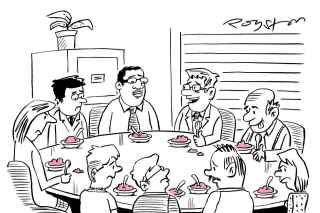
“Owing to the very real threat of biscuit-related injuries, the snack of choice for meetings will now be blancmange.”
Falls from height lead to prosecutions for companies on both sides of the Tasman
Two falls from height incidents on different sides of the Tasman have resulted in devastating outcomes for workers, and convictions and fines for businesses.
KiwiRail has been fined $220,000 and ordered to pay reparations of $28,500 after a worker fell 10 metres while installing a telecommunications pole in Whanganui. The worker sustained serious injuries including nine fractured vertebrae, five fractured ribs, a broken sternum, a punctured left lung, a torn liver and a torn artery. Remarkably, after 10 months, he returned to work.
The pole being worked on at the time of the incident was a new design for KiwiRail, and different from the wooden poles workers had previously used. However, the WorkSafe investigation found that KiwiRail failed to carry out a detailed specific risk assessment to consider if changes in controls were needed, there were no dedicated procedures developed, and workers lacked training in risk assessment for complex work at height. A fall arrest system was installed but was not in use at the time and climbing pegs on the pole had been incorrectly installed.
KiwiRail also failed to provide safer methods to do the job, such as a mobile elevated work platform. WorkSafe said that businesses must first ask whether the job can be done from the ground to eliminate the fall risk. If not, it says businesses should consider using an elevated work platform or scaffolding. Fall arrest systems should be the last line of defence – not the first option.
Meanwhile in Melbourne, Australia, a laundry operator has been fined AU$270,000 under that State’s health and safety laws after a driver employed by a contractor died in a 1.2 metre fall from a truck’s elevated tailgate. The company was also ordered to pay costs of AU$8,500. The victim’s employer is still before the Court.
The laundry operator engaged a transport company to provide vehicles and approved truck drivers to support its collection and delivery service. On arrival at the laundry, the driver would reverse into a dock and lower the truck’s tailgate to form a bridge to load and unload laundry trolleys.
A WorkSafe Victoria investigation found the truck involved in the incident did not have fall protection handrails installed at the time, and the laundry operator admitted it was reasonably practicable to have reduced the risk of a fall by installing swing gates at the dock, which could be used when trucks without safety handrails were being loaded and unloaded.
Falls from height remain a leading cause of death and injury in workplaces. Twenty-seven workers died from falls from height in New Zealand between January 2020 and December 2024. From July 2024 to June 2025, 2,076 workers sustained injuries resulting in more than a week away from work – an average of 173 per month. Guidance on working safely at height can be found on the WorkSafe website and the WorkSafe Victoria website.
WorkSafe issues new Statement of Intent signalling more education, engagement and EUs
WorkSafe has issued a new four-year plan resetting how it operates which it says will put educating and engaging with businesses in the spotlight, whilst delivering proportionate enforcement when needed. The Statement of Intent (2025/26 to 2028/29) reflects a shift in the regulator’s strategic priorities with a much stronger focus on its educate and engage roles and a more “holistic and nuanced” approach to enforcement.
WorkSafe has highlighted three key changes. It says it will provide clearer guidance and support to business through practical information tailored to real-world conditions. It will also target engagement with proactive partnerships and sector-led initiatives in high-risk industries.
And it will focus on proportionate enforcement when obligations aren’t being met, with a greater use of enforceable undertakings as an alternative to prosecution.
The regulator also says it is making a significant investment in inspector training and capability to ensure businesses experience consistent, constructive engagement across the country. In addition, there will be more investment in digital technology and data insights to make compliance simpler and more efficient.
You can read the full WorkSafe Statement of Intent 2025-2029 here.
Victoria introduces new regulations to make psychological health a priority
Employers in Victoria, Australia, must now take specific steps to identify psychosocial hazards and control work-related risks to mental health. The Occupational Health and Safety (Psychological Health) Regulations 2025 came into force on 1 December 2025 and create new obligations for workplaces across Victoria to protect employees from psychological injury.
The regulations provide the flexibility for duty holders to identify and control psychosocial hazards and risks in the way that best supports their working environment.
A psychological health compliance code has been published to provide practical guidance to employers about their obligations, including definitions of psychosocial hazards and examples of how they might apply across different types of workplaces.
WorkSafe Victoria says that just like physical injuries, psychological injuries can take a terrible toll on workers’ lives, and the new regulations make it absolutely clear the steps employers must take to identify hazards and control the associated risks.
Auckland Council RMA prosecutions result in convictions and fines for doggy daycare and developer
Two prosecutions by Auckland Council under the Resource Management Act (RMA) have resulted in convictions and fines for a doggy daycare operator and a developer. Both came about after repeated warnings and enforcement actions by the Council.
In the first case, a land developer was fined $48,750 following unauthorised earthworks and failures to control sediment discharges on Auckland’s North Shore.
The company was granted resource consent in November 2020 with conditions that included proper erosion and sediment management, stabilisation of bare areas and prevention of discharges onto public roads or neighbouring land.
However, council inspections found ongoing non-compliance issues, despite repeated warnings and the issuance of an Abatement Notice. Sediment from the sites flowed onto neighbouring properties and into waterways.
The court rejected the company’s claim that it was only minimally responsible because contractors had carried out the work. The Judge found that as the landowner and an experienced property developer, the company had “turned a blind eye” to what was happening on its land and failed to take reasonable steps to prevent harm. “It would not have taken a great effort to visit and check,” the Judge said.
In the second case, a rural doggy daycare business, and its sole director and shareholder, were each fined $51,562.50 for repeated breaches of court orders and ongoing non-compliance with the RMA. This followed earlier convictions in May 2024, when they were fined $77,750 for ongoing breaches of their resource consent between September 2021 and August 2022.
The charges stemmed from unauthorised large-scale dog daycare and boarding activities that far exceeded approved limits for dog numbers, operating hours, fencing standards and exercise areas. Auckland Council took multiple enforcement steps including abatement notices and a May 2023 enforcement order to limit impacts while allowing time for the business to comply or relocate.
Despite this, the company continued operating in breach of the orders, generating fresh community complaints about noise, traffic and loss of amenity.
This newsletter is published as part of Vero Liability’s commitment to supporting better work health and safety outcomes for all New Zealanders. We want everyone to go home safe.
Vero Liability provides a full range of liability insurance products suitable for almost any business or operation in New Zealand. Our extensive range of liability products include Professional Indemnity, Directors and Officers Liability, Public and Products Liability, Statutory Liability, LegalEdge and other specialty products. We support these products with an experienced team of insurance underwriters, specialist claims lawyers and managers to ensure our policyholders get early and effective help with unexpected legal issues.
For more information on VL’s specialist liability insurance products, including our statutory liability cover for non-deliberate health and safety breaches, visit our website.